

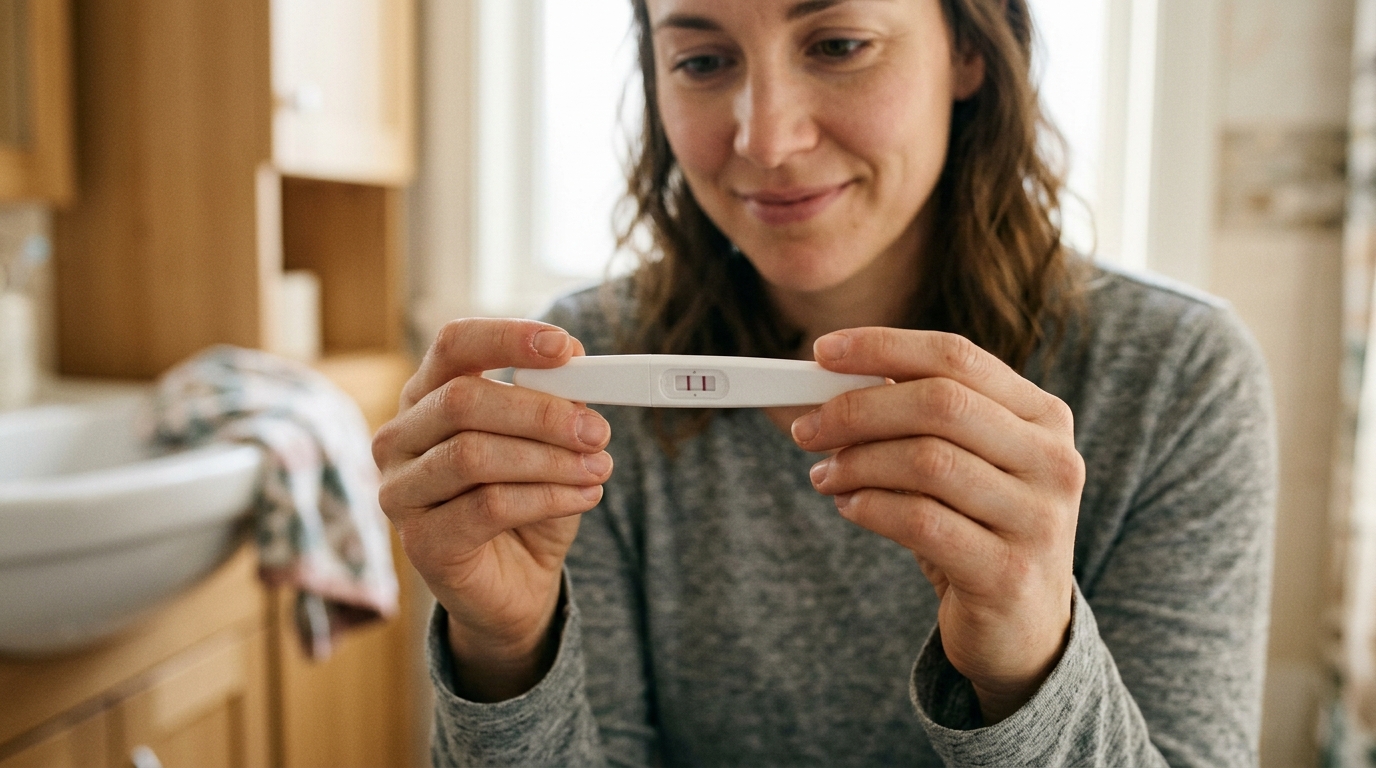

Seeing a positive pregnancy test after an embryo transfer can be a big moment.
After all the preparation that goes into a surrogacy journey, seeing those two lines may bring excitement, relief, nervousness, or a whole mix of emotions. For the intended parents, it can be an emotional milestone, too.
But a positive home pregnancy test is just the beginning of the next step.
A home test tells you that it has detected human chorionic gonadotropin (hCG), the hormone produced during pregnancy. It does not tell you yet how the pregnancy is developing or whether everything is progressing normally.
That's why your fertility clinic will continue monitoring you after a positive test. Bloodwork and, later, an ultrasound will provide much more information than a home test can.
And while you wait for those next milestones, it's completely normal to feel a little bit of everything.
Medical Disclaimer: The information in this article is for general educational purposes only and is not intended to provide medical advice, diagnosis, or treatment. Every surrogacy journey and pregnancy is different. Always follow the instructions and recommendations of your fertility clinic and healthcare providers, who can provide guidance based on your individual medical history and circumstances. Do not start, stop, or change medications or treatment based on information in this article. If you have urgent or concerning symptoms, contact your healthcare provider or seek emergency medical care as appropriate.
Key Takeaways
- A positive home pregnancy test after embryo transfer is an encouraging milestone, but additional testing is needed to confirm the pregnancy and monitor its development.
- Testing too early can lead to confusing results, and some fertility medications containing hCG can cause a temporary positive result.
- Your fertility clinic will typically use quantitative beta hCG bloodwork and, later, an ultrasound to monitor the pregnancy.
- A positive test can be exciting and emotional for both the surrogate and intended parents. Clear communication can help everyone navigate the waiting period.
- Severe or one-sided abdominal pain, heavy bleeding, dizziness, fainting, or shoulder pain should be reported to your medical team promptly.
- If you are working with a surrogacy agency in North Carolina, your agency can provide support and coordination while your fertility clinic handles your medical care and your attorney handles legal questions.
What Does a Positive Pregnancy Test Mean After Embryo Transfer?
A positive pregnancy test means that the test has detected hCG.
In a surrogacy journey, that can feel like a huge moment. You've spent weeks preparing for the transfer, following your medication schedule, and waiting to find out whether the embryo successfully implanted.
But an at-home pregnancy test cannot tell you everything that is happening.
A positive test does not confirm how the pregnancy is developing, and it does not confirm the pregnancy's location. That's why your fertility clinic will continue with additional testing.
It's helpful to think of a positive home test as an exciting first step, not the final answer.
When Should You Take a Pregnancy Test After Embryo Transfer?
It can be incredibly tempting to take a pregnancy test as soon as possible after transfer.
The problem is that testing too early can create more questions than answers.
Your fertility clinic will give you a specific date for pregnancy testing, based on your treatment and the timing of your embryo transfer. Many clinics use a blood test around 9 to 14 days after transfer, but your clinic's instructions should always be your guide.
Testing early can result in a negative test even when a pregnancy is developing simply because hCG levels are not yet high enough to detect.
On the other hand, some fertility medications contain hCG and can affect an early pregnancy test.
For those reasons, try to resist the urge to read too much into an early home test. If you do test early and get a result that surprises you, let your fertility clinic know rather than trying to interpret it on your own.
Can Fertility Medication Cause a False Positive?
Some fertility treatment protocols include medications containing hCG.
Because pregnancy tests detect hCG, medication containing the hormone can sometimes cause a positive result before hCG produced by a pregnancy would be expected to do so.
How long the medication remains detectable can vary, so there isn't one exact number of days that applies to everyone.
Your fertility clinic knows which medications you've taken and when you've taken them. That's why your clinic's testing schedule is much more reliable than trying to determine what an early home test means on your own.
What Happens After a Positive Pregnancy Test?
Once you have a positive result, your fertility clinic will typically confirm the pregnancy with bloodwork.
This is where things become a little more scientific than the two lines on a home test.
Beta hCG Bloodwork
A quantitative beta hCG test measures the amount of hCG in your blood.
Unlike a home pregnancy test, which generally tells you whether hCG is detected, a quantitative blood test gives your care team an actual number.
Your clinic may repeat the test after a period of time to look at how the level is changing.
A rising hCG level can be reassuring, but it is important to remember that hCG alone cannot tell your care team everything they need to know about the pregnancy.
Early Ultrasound
Once the pregnancy has progressed far enough, your fertility team will schedule an ultrasound.
The ultrasound can help confirm that the pregnancy is located in the uterus and evaluate early development. Later in early pregnancy, the ultrasound may also show cardiac activity.
The timing of that first ultrasound varies based on your clinic's protocol and your individual circumstances.
This is why there can be several milestones between your first positive test and the point when your fertility team can give you a more complete picture of how the pregnancy is progressing.
What If the Pregnancy Test Is Faint?
A faint line can be especially stressful because it can leave you wondering what it means.
A faint result may happen because you tested early, your urine was diluted, or hCG levels are still relatively low.
It can also be difficult to interpret an early test if you have recently taken an hCG-containing medication.
Rather than taking multiple tests and trying to compare the darkness of each line, contact your fertility clinic and follow the testing schedule they have provided.
Your medical team can give you a much clearer answer with the appropriate bloodwork.
What If the Positive Test Doesn't Continue?
Sometimes a pregnancy begins but does not continue.
A chemical pregnancy is a very early pregnancy loss that happens before the pregnancy can be confirmed on ultrasound. It may be detected through an initial positive pregnancy test or bloodwork followed by falling hCG levels.
If this happens, it can be incredibly difficult.
For a surrogate, there may be a complicated mix of emotions. You may feel sadness, disappointment, concern for the intended parents, or uncertainty about what you're supposed to feel.
For intended parents, an early loss can be heartbreaking after everything that has already gone into building their family.
There is no right emotional response.
Your fertility clinic can explain what is happening medically and what comes next. Your agency can also provide support as you and the intended parents process the experience.
Understanding Ectopic Pregnancy
One reason your medical team continues monitoring after a positive pregnancy test is to confirm where the pregnancy is developing.
An ectopic pregnancy occurs when a pregnancy develops outside the uterus, most commonly in a fallopian tube. An ectopic pregnancy can become a medical emergency.
Contact your healthcare provider promptly if you experience concerning symptoms such as:
- Severe or worsening abdominal or pelvic pain
- Pain that is especially strong on one side
- Heavy bleeding
- Dizziness or weakness
- Fainting
- Shoulder pain
Do not wait for a scheduled appointment if you are experiencing severe symptoms. Seek emergency medical care.
Your fertility clinic should also tell you what symptoms they want you to report and who to contact after hours.
What Should I Do While I Wait?
The waiting period between a positive test, bloodwork, and your first ultrasound can feel surprisingly long.
You may find yourself wanting to know what every symptom means.
Try to remember that early pregnancy symptoms can vary widely. You may experience cramping, spotting, breast tenderness, fatigue, or other symptoms. You may also feel completely normal.
Symptoms—or the lack of symptoms—cannot reliably tell you whether everything is progressing normally.
Instead of trying to analyze every sensation, keep following the instructions from your fertility clinic and reach out when you have a question.
And give yourself some grace during the waiting period. This is a meaningful moment in your surrogacy journey, and it is okay to feel emotional about it.
Communicating With the Intended Parents
A positive test can be an incredibly exciting moment for intended parents.
They may be eager to hear the news and understand what happens next. At the same time, the surrogate is the one experiencing the physical and emotional side of early pregnancy.
This is a good time to lean on the communication plan you've already established.
Talk about how you want to share updates, when you expect to receive information from the clinic, and how frequently you want to communicate while you're waiting for bloodwork and ultrasound results.
There is no perfect communication schedule.
Some surrogates enjoy sharing updates throughout the process. Others prefer to wait until there is more information before having frequent conversations.
What matters is that everyone understands what feels comfortable.
Your agency can help facilitate communication if questions or emotions become difficult to navigate.
A Positive Pregnancy Test in a North Carolina Surrogacy Journey
For surrogates working with a North Carolina surrogacy agency, a positive pregnancy test is the beginning of another stage of coordination between you, your fertility clinic, your intended parents, your agency, and your legal team.
Your fertility clinic will be responsible for your medical care and will determine the appropriate schedule for bloodwork, ultrasounds, medications, and appointments.
Your agency can help coordinate communication and provide practical and emotional support throughout the journey.
Your attorney remains the right person to contact with legal questions about your surrogacy agreement, parentage, or other legal matters.
This division of responsibilities is important. You should always receive medical advice from your healthcare team and legal advice from your attorney rather than trying to navigate those questions through general online information.
Whether you're working with a fertility clinic in Chapel Hill, Raleigh, Durham, Charlotte, or elsewhere in North Carolina, your clinic will give you the instructions specific to your pregnancy and treatment plan.
What Happens Next?
A positive pregnancy test is exciting, but there are still several steps ahead.
Your fertility clinic will continue monitoring you with bloodwork and eventually an ultrasound. You'll continue any medications as directed, attend your scheduled appointments, and receive more information as the pregnancy progresses.
You don't need to have everything figured out today.
Take the next step as it comes.
Celebrate the positive test if that feels right to you. Let yourself feel nervous if you're nervous. Ask questions when you have them. And lean on the people who are there to support you.
Your Village Is Here, Too
A positive pregnancy test can feel like the moment a surrogacy journey suddenly becomes very real.
At Village Surrogacy, we know there can be a lot of emotion packed into those two lines. There may be excitement, hope, nerves, and a whole lot of questions about what happens next.
You don't have to navigate those questions alone.
Your fertility clinic is there for your medical care. Your attorney is there for your legal questions. And your Village is here to support you through the journey, help keep communication moving, and remind you that you're part of something bigger than a single test result.
For our North Carolina surrogates, we're proud to be a local team supporting journeys throughout the Triangle and beyond.
One positive test doesn't answer every question.
But it does mark the beginning of the next chapter.
Learn more about becoming a surrogate with Village Surrogacy.
Frequently Asked Questions
1. What does a positive pregnancy test mean after embryo transfer?
A positive pregnancy test means the test has detected hCG. It is an encouraging milestone, but additional bloodwork and ultrasound are needed to determine how the pregnancy is progressing.
2. When should I take a pregnancy test after embryo transfer?
Follow the testing date provided by your fertility clinic. Many clinics schedule a blood pregnancy test around 9 to 14 days after transfer, but timing varies based on the treatment protocol and embryo transfer.
3. Can fertility medication cause a false-positive pregnancy test?
Yes. Some medications used during fertility treatment contain hCG, which can be detected by a pregnancy test. Your fertility clinic can explain whether your medications could affect an early test and when testing will provide a more reliable result.
4. What is a beta hCG test?
A quantitative beta hCG test is a blood test that measures the amount of hCG in your bloodstream. Your fertility clinic may repeat t